
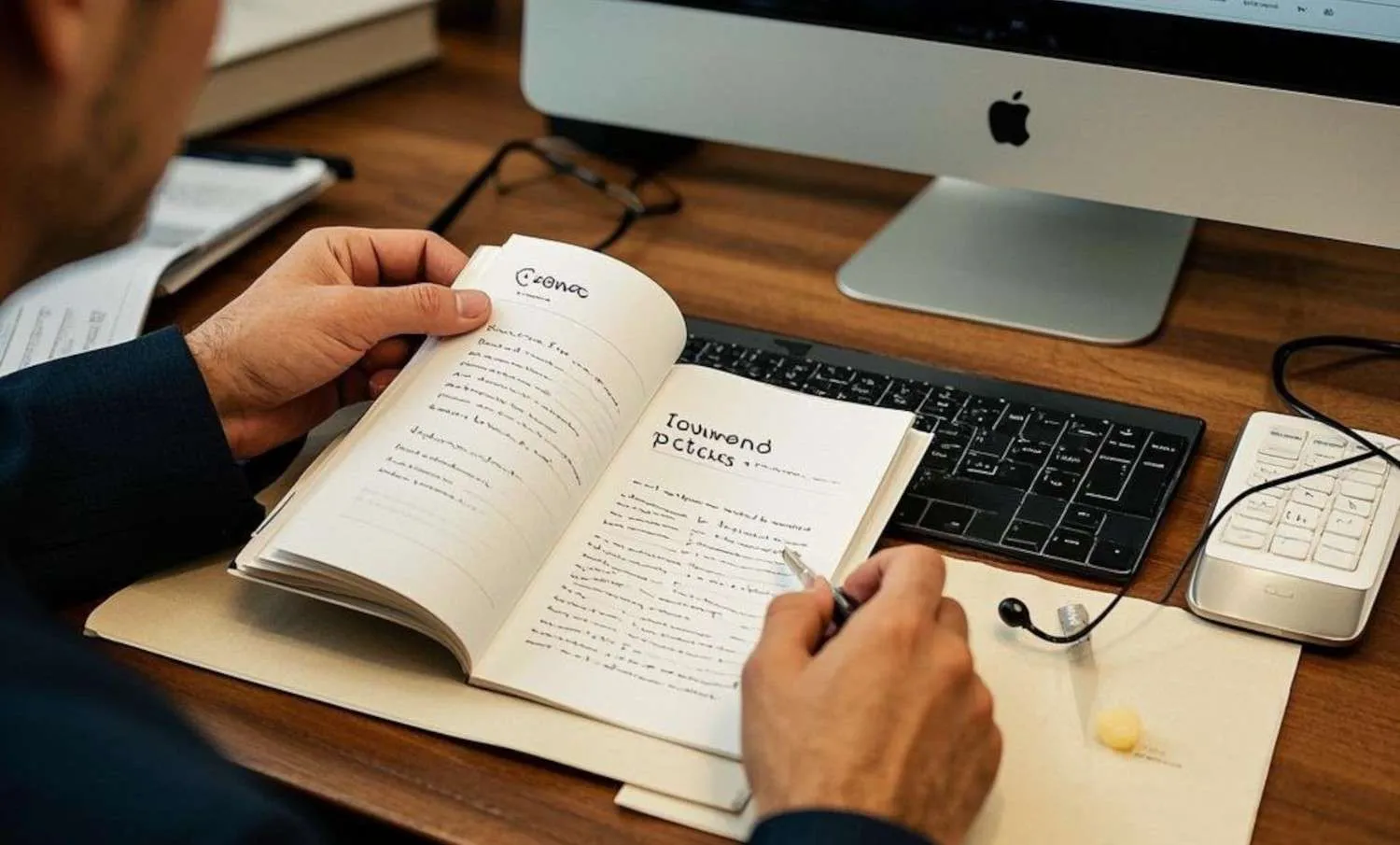
To prepare your manuscript for professional proofreading, you must finalize the content, standardize the formatting, and create a comprehensive style guide so your proofreader can focus strictly on catching surface-level errors rather than fixing structural issues.
A professional proofreader is your final line of defense, meaning your document should already be as polished and clean as possible before it reaches them.
1. Finalize the Story and Text
Proofreading is the very last stage of production. Making major developmental or structural changes after a proofreader has worked on your text will introduce new errors and waste your money.
- Complete all revisions: Ensure no chapters, scenes, or paragraphs require rewriting.
- Lock the text: Do not add new content after sending the file to the proofreader.
- Resolve placeholders: Search your document for temporary tags like “TK,” “XYZ,” or highlighted notes and replace them with final text.
2. Standardize Your Formatting
Clean, predictable formatting allows a proofreader to spot anomalies quickly. Unless your publisher or journal requires a specific house style sheet, apply standard industry layout settings:
- Font: Use a clear, standard font like 12-point Times New Roman or Arial.
- Spacing: Double-space the text and use standard 1-inch margins.
- Indents: Set paragraph indents using your word processor’s paragraph layout settings, never by hitting the spacebar or the Tab key.
- Page numbers: Insert consecutive page numbers in the header or footer.
- Breaks: Use formal page breaks to separate chapters instead of hitting “Enter” repeatedly.
3. Build a Style Sheet
A style sheet gives your proofreader a blueprint of your intentional creative and linguistic choices. Provide a document detailing:
- Target language: Explicitly state if you are using US English, UK English, Canadian English, or another regional variant.
- Style guide: Specify if your work follows standard frameworks like the Chicago Manual of Style (for fiction/non-fiction), APA, or MLA (for academic work).
- Character and place names: List every major name with its correct spelling to prevent accidental inconsistencies (e.g., Jon vs. John).
- Invented words: Include a mini-glossary of sci-fi, fantasy, or industry-specific jargon.
- Formatting choices: Clarify your preferred conventions, such as your stance on the Oxford comma or numbers written as words versus numerals.
4. Perform a Preliminary Self-Clean
Do not rely on a professional to fix basic mistakes that you can catch yourself in a few minutes. Cleaning the manuscript first ensures the proofreader can focus on deeply hidden bugs:
- Run spellcheck: Use your software’s spellcheck tool to quickly sweep for obvious typos.
- Check layout elements: Scan all headings, subheadings, and chapter titles to confirm they follow identical styling and capitalization rules.
- Verify non-text elements: Double-check the numbering and labels for all tables, charts, and captions.
- Test hyperlinks: If you are writing non-fiction or an e-book, click every external URL to ensure they are live and accurate.
5. Prepare the File Layout
Ensure your delivery package contains clear, accessible files:
- File format: Save your text in an easily editable format, typically a standard Microsoft Word document (.docx), as most editors rely heavily on its Track Changes feature.
- File organization: Combine your manuscript into a single master document rather than sending separate files for individual chapters.
- Anonymization: Strip out your name and affiliations from the document properties if you are submitting to a double-blind peer-review pipeline.
To prepare manuscript proofreading correctly, an author should finish all major revisions, clean the working file, record style choices, and send one clearly labeled final version. Otherwise, late rewrites can create fresh errors and force the proofreader to check moving text. A controlled handoff makes the last review accurate and easier to manage.
Key Takeaways
- Developmental editing and copyediting should be complete before proofreading begins.
- A manuscript ready for review has no unresolved comments, tracking, or missing material.
- The handoff should include a style sheet, query list, and clear instructions.
- A formatted proof is needed when layout errors must also be checked.
How should writers prepare manuscript proofreading
First, writers should treat proofreading as the last correction stage, not as another rewrite. According to Purdue OWL, proofreading is usually the final pass before submission or publication, while developmental, substantive, and copyediting work comes earlier.
Therefore, plot repairs, chapter moves, new research, and major sentence rewriting should be complete before the proofreader receives the file. An author who still expects large changes needs editing, not a final proof.
What should be finished before proofreading begins
Next, the manuscript should have approved content, stable chapter order, and complete front and back matter before proofreading starts. A professional proofreading prep pass should cover the title page, copyright page, dedication, contents, acknowledgments, notes, bibliography, appendices, captions, and author biography when those items apply.
Authors who need deeper sentence or structural work should arrange Editing and Proofreading Services before declaring the text final. However, service labels can overlap among providers. Therefore, the written scope should state whether the proofreader will correct typographical errors only or also flag consistency, grammar, references, and layout problems.
| Not ready for proofreading | Ready for proofreading |
| Chapters are still moving | Chapter order is approved |
| Comments contain open decisions | Queries are answered or listed |
| Several files compete as the latest copy | One master file has a clear version name |
| Citations or captions are missing | Supporting material is present |
| Style choices change by chapter | Choices appear on a style sheet |
How should the manuscript file be cleaned
Then, the author should remove hidden uncertainty without erasing useful editorial history. First, each tracked change in Microsoft Word should be reviewed and accepted or rejected. After that, resolved comments should be deleted, while any unanswered issue should move to a separate query list for the proofreader.
According to Microsoft Support, choosing No Markup only hides tracked changes; it does not remove them. Microsoft also recommends Document Inspector to check for comments, hidden text, tracked changes, personal names in properties, and other stored information before sharing a document.
A practical file name contains the title, stage, and date, such as RiverHouse_PROOF_2026-08-15.docx. In addition, the author should keep an untouched backup and send one master file.
What belongs in a before proofreader checklist
A before proofreader checklist should confirm content, consistency, file condition, and handoff details. Specifically, it should include the following items:
- Confirmation that every chapter and section is present.
- Consistent forms for names, dates, places, and specialized terms.
- Agreement between headings and the table of contents.
- Complete notes, tables, images, and captions.
- Resolution of tracked changes and comments, or an explanation for each open item.
- A style sheet and a short list of known concerns.
- The required file type, deadline, and method for returning corrections.
A style sheet is a record of editorial decisions, not a second manuscript. It can list character names, capitalization, spelling preferences, number treatment, hyphenation, timeline facts, and a chosen guide such as The Chicago Manual of Style. Consequently, the proofreader can apply the same choice from the first chapter to the last.
Should the proofreader receive a Word file or a PDF
The correct format depends on the stage and the work requested. A Microsoft Word file suits text corrections and Track Changes. In contrast, a PDF is better when page numbers, running heads, line breaks, widows, orphans, captions, and spacing must be reviewed after layout.
When both text and design matter, the proofreader may need the editable manuscript plus the formatted PDF. According to Adobe Help Center, Acrobat Pro can compare two PDF versions and report differences. Its settings can compare text only or include formatting and graphic elements, depending on the document type.
However, software comparison does not replace human reading. It can reveal changes between files, but it cannot decide whether a character’s eye color is consistent or whether a heading sounds wrong in context. Therefore, tools should support the proofreader rather than define the full review.
What should the handoff note tell the proofreader
The handoff note should define the assignment in a few precise lines. It should name the style guide, audience, English variant, file stage, permitted changes, return format, and deadline. Additionally, it should identify material that must remain unchanged, such as quotations, dialect, scripture wording, trademarks, or legal language.
Who benefits most from professional proofreading
Specifically, professional proofreading helps authors whose edited text needs an independent final check. It is especially useful for long manuscripts, citation-heavy nonfiction, repeated timelines, and formatted page proofs.
That said, proofreading has a clear limitation. A proofreader may flag a doubtful fact or unclear sentence, but fact-checking, permissions research, legal review, and major rewriting are separate services unless the contract says otherwise. Consequently, the author remains responsible for confirming the agreed scope before work begins.
FAQs
How final should a manuscript be before proofreading
A manuscript should be content-final before proofreading begins. Its chapters, examples, notes, and front and back matter should be present and approved. Minor corrections may still occur. However, planned rewrites or structural changes mean the book needs another editing round before the proofreader starts.
Should an author accept all tracked changes first
An author should review every tracked change, but should not accept everything without checking it. Each change should be accepted or rejected deliberately, and open questions should be listed separately. Therefore, the proofreader receives readable text without losing unresolved decisions that could affect accuracy.
Does a proofreader need the style sheet
A proofreader should receive the style sheet whenever one exists. It records choices for spelling, capitalization, numbers, names, timelines, and special terms. As a result, the proofreader can test the manuscript against approved decisions instead of guessing which variation the author intended.
Can proofreading happen before book formatting
Proofreading can happen before formatting when the assignment covers text only. However, a second proof of the designed pages is wise when page-level details matter. Running heads, line breaks, captions, spacing, and contents page numbers do not appear in their final form until layout is complete.
What files should be sent to a professional proofreader
A professional proofreader should receive one clearly named master file, the style sheet, and a brief handoff note. Additionally, the package may include a formatted PDF, source list, image and caption list, or query log. Duplicate drafts should stay out of the handoff folder.
Where can writers review the editing scope
Writers can review manuscript editing services to compare developmental editing, line editing, copyediting, and proofreading before choosing the final stage. This review belongs immediately before the handoff because the wrong service level can leave major problems outside a proofreader’s agreed scope.
Conclusion
To prepare manuscript proofreading successfully, an author should freeze the content, resolve file markup, assemble a style sheet, choose the right proof format, and explain the scope. These steps give the proofreader a stable text and clear standards. Canadian Ghostwriters can then discuss the appropriate final review without pushing a manuscript into proofreading too early.