

Proofreading is the ultimate quality-control stage because it occurs after the book has been fully edited, formatted, and typeset. Unlike earlier stages of editing that focus on changing or restructuring text, proofreading is a “cold read” designed to catch surface-level errors before the files go to print or digital distribution.
The Publishing Workflow
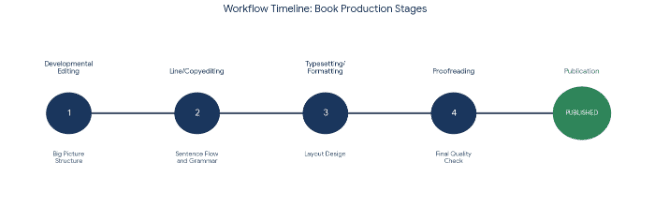
The editorial timeline dictates exactly why proofreading cannot happen any earlier. Writing a book follows a strict, linear pipeline where each step addresses a smaller layer of detail.
4 Reasons Proofreading is the Final Step
- Fixes Layout Errors: Formatter and interior design software can introduce brand-new mistakes. Proofreaders check for bad line breaks, missing headers, or overlapping text.
- Protects Your Budget: Making major content edits after typesetting forces a layout artist to rebuild the book. Changing a sentence can throw off the pagination of all subsequent chapters.
- Catches Leftover Typos: Copyeditors focus heavily on syntax, clarity, and phrasing. Proofreaders serve as a fresh set of eyes to catch remaining punctuation slips or double spaces.
- Verifies Technical Elements: This pass checks the final table of contents page numbers against the actual pages. It also confirms proper image captions and page numbering.
How Proofreading Compares to Copyediting
| Feature | Copyediting | Proofreading |
| Timing | Before the book layout is designed. | After the book layout is designed. |
| Main Focus | Sentence flow, word choice, and clarity. | Layout issues, typos, and minor mechanics. |
| File Type | Raw text document (e.g., Word, Google Doc). | Formatted print proof or e-book file. |
| Changes | High (rewriting or shifting text blocks). | Low (only fixing critical mistakes). |
Proofreading before publishing is the final quality check performed after editing and book formatting. It catches small text and layout errors in the pages readers will receive. Without that last review, a polished manuscript can reach the market with broken headings, stray typos, or incorrect page elements.
Such faults distract readers and weaken confidence. Therefore, the solution is a controlled review of the print PDF and eBook, followed by a correction check. This sequence confirms publishing readiness without reopening the manuscript for major rewriting.
Key Takeaways
- Proofreading checks the formatted proof after the main editing stages are complete.
- A final manuscript check covers words, consistency, page layout, front matter, and book metadata.
- Print and eBook files need separate reviews because they display differently.
- Automated tools help locate patterns, but a trained human must judge context and layout.
- Major rewriting during proof stage can create new errors and disturb settled page breaks.
Why Does Proofreading Before Publishing Come Last
Proofreading comes last because it examines the near-final book, including language and layout. According to the Chartered Institute of Editing and Proofreading, its January 11, 2024, guidance defines proofreading as the final production stage before a text is published or shared. The institute also notes that corrections must fit the page layout.
Earlier editing asks whether the story, argument, and sentences work. In contrast, proofreading asks whether the approved text survived typesetting and conversion without fresh faults. For example, a line may wrap badly or a chapter title may use the wrong style.
That timing matters because layout changes can alter page count and cross-references. Therefore, substantial revisions should finish before proof stage. A proofreader can flag a serious issue, but routine rewriting belongs earlier.
What Does a Final Manuscript Check Catch
A final manuscript check catches residual text and production faults in the finished pages. Professional Editing and Proofreading Services examine the proof copy as a physical or screen-based product. Consequently, the scope is wider than a spelling pass.
Which text errors remain after editing
Specifically, residual text errors include misspellings, doubled words, punctuation slips, and inconsistent capitalization. A proofreader also compares number treatment, hyphenation, names, and headings against the book’s style sheet. For example, “email” should not become “e-mail” halfway through a business book.
Which layout errors appear in proofs
Layout errors include incorrect folios, spacing, page breaks, and running heads. In addition, proofreaders inspect front matter, tables, notes, references, and blank pages. They also flag widows and orphans, which are short stranded lines at a page edge.
In contrast, print proofs require attention to fixed pages and gutters, while reflowable eBooks need testing at different text sizes. Therefore, a clean PDF does not prove that an EPUB will display correctly on Kindle devices and apps.
According to the Chicago Manual of Style, copyeditors commonly work in Microsoft Word or Google Docs before proofreaders review pages formatted in Adobe InDesign. Furthermore, proofreaders often mark a PDF instead of editing the production file. Adobe Acrobat comments preserve a clear correction trail.
How Is Proofreading Different From Copyediting
Proofreading corrects remaining faults in final pages, while copyediting improves the manuscript before layout. Although the services overlap, their purpose and freedom to change text differ.
| Area | Copyediting | Proofreading |
| Production stage | Before formatting | After formatting |
| Working file | Word or Google Docs manuscript | PDF, print proof, or final eBook file |
| Main focus | Grammar, clarity, and consistency | Residual errors, layout, and correction accuracy |
| Change level | Sentence-level edits may be appropriate | Changes should be limited and necessary |
| Main record | Tracked changes and style sheet | Marked proof and correction log |
However, proofreading cannot repair weak structure, missing evidence, or confusing chapter order within a normal proof-stage schedule. Instead, those problems should return to the proper editing stage, even if publication must wait.
How Can Authors Check Publishing Readiness
Authors confirm publishing readiness by reviewing stable files in order. Specifically, separate language, layout, and platform checks prevent one task from hiding another.
- Freeze the text and label final files.
- Read the full interior, including front and back matter.
- Compare names, titles, references, ISBN details, and cover copy.
- Enter approved corrections, then inspect every changed page.
- Finally, preview both files on the intended publishing platform.
According to Amazon KDP, Print Previewer checks margins, cover size, and fonts before submission, and Amazon performs a manual file review afterward. However, technical review does not replace proofreading. It cannot reliably judge a swapped character name or incorrect memoir date.
Who Should Proofread the Final Proof
A trained proofreader who did not write the book is the strongest choice. For instance, familiarity makes authors read the intended sentence instead of the printed one. Moreover, a fresh reader is more likely to notice repeated words, mismatched headings, and missing lines.
Similarly, authors can strengthen a self-check by changing the display, using text-to-speech, and reviewing isolated elements. Even so, Microsoft Word spellcheck and Grammarly are filters, not final judges. They can miss factual inconsistencies, valid names, intentional dialogue, and page faults.
For an independent release, professional help is most useful after design is stable. Canadian Ghostwriters can connect final checks with professional self-publishing support. Still, the author must approve facts, quotations, permissions, and final wording.
What Happens If a Book Is Published With Errors
Publishing with errors can lead to complaints, replacement files, and extra work. More importantly, proofreading importance becomes clear when a fault pulls attention from the story or argument. Printed copies may preserve that mistake until another order.
However, post-release fixes must still move through retailer files, print inventory, review copies, and reader devices. Therefore, prevention is simpler than correction.
FAQs
Is proofreading always the final editing stage
Yes, proofreading is normally the final editorial stage because it checks the formatted proof just before publication. Developmental editing, line editing, and copyediting should already be finished. However, if a proofreader finds a major structural or factual problem, the book may need to return to an earlier stage before release.
Should a book be proofread before or after formatting
A book should receive its final proofread after formatting because page design can introduce new errors. For example, words may disappear, headings may change style, and page breaks may become awkward. Authors may check spelling earlier, but the formal proofread should examine the print PDF and final eBook file.
Can an author proofread a book without hiring someone
An author can self-proofread, but the method has a clear limitation because familiarity hides errors. Better results come from resting the manuscript, changing the display, reading aloud, and checking one error class at a time. Nevertheless, an independent proofreader provides fresh attention and stronger quality control for a commercial release.
How many proofreading passes does a book need
A book needs enough passes to check text, layout, and entered corrections, but no universal number fits every project. A practical process uses one full proofread and one correction check. Complex nonfiction with tables, notes, references, or indexes may require separate passes by people with the right subject knowledge.
Which editing service does a manuscript need before proofreading
The required service depends on the manuscript’s condition, not its publication date. Structural problems call for developmental editing, awkward prose may need line editing, and grammar or consistency faults require copyediting. The guide to the types of book editing helps authors identify the correct stage before ordering a final proofread.
Conclusion
Proofreading before publishing is the release gate between an edited manuscript and the book readers receive. It checks remaining language faults, page elements, file consistency, and entered corrections. Therefore, authors should review stable print and eBook files rather than treating spellcheck as the final step.
A careful final proof protects the reader’s attention and gives the author a clear approval point. Finally, Canadian Ghostwriters can arrange that review once the manuscript is edited and formatted.