
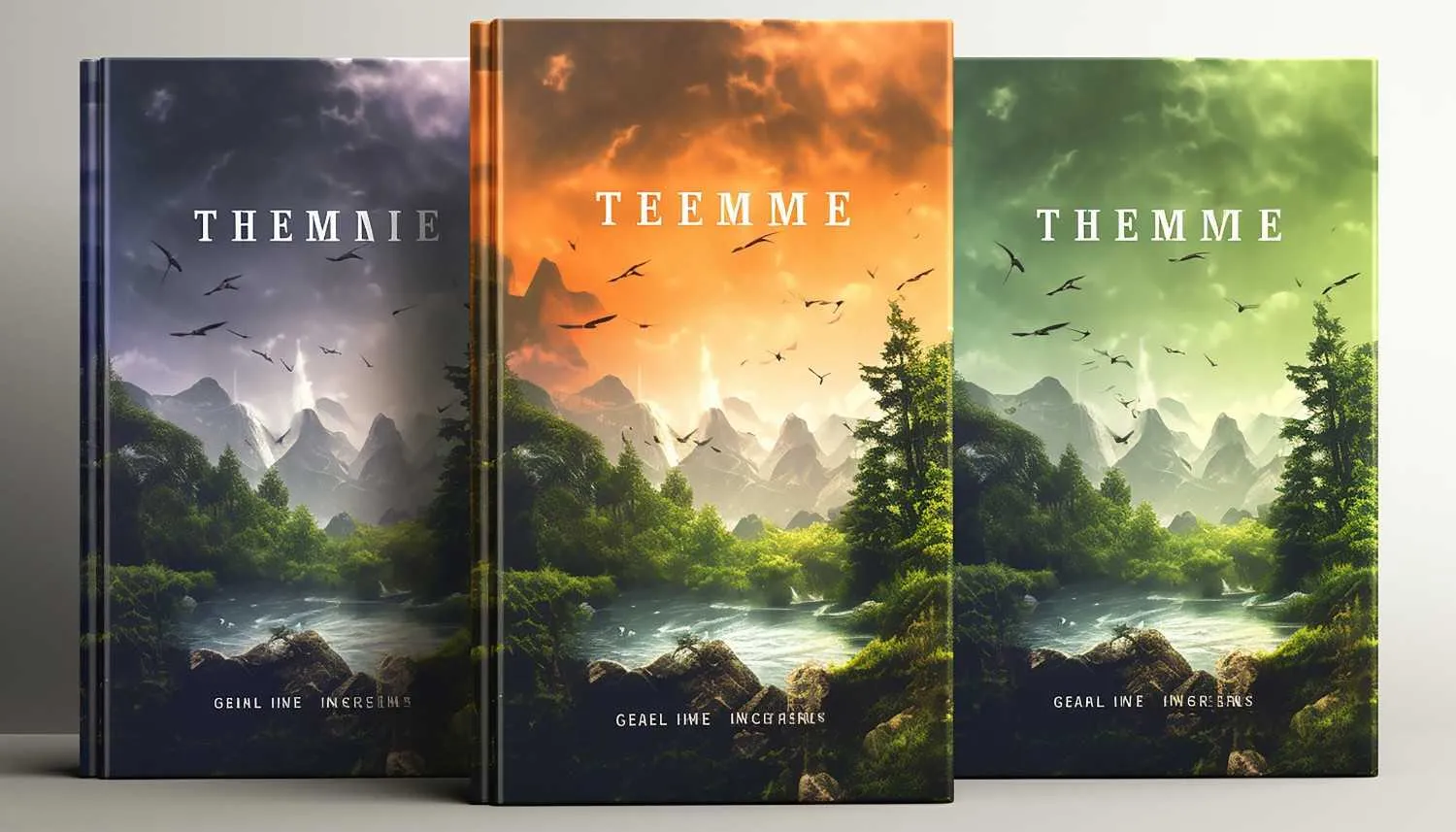
Professional book cover designers create market-ready fiction covers by balancing artistic storytelling with strict commercial standards to ensure a book instantly signals its genre and converts browsing clicks into sales. Data shows that a professional cover can increase a book’s marketability by an average of 35%, elevating online click-through rates by up to 50% compared to amateur designs.
The precise step-by-step process professional designers use to build high-converting fiction covers involves detailed market positioning, visual psychology, and digital optimization.
Phase 1: Deep Research and Market Positioning
Before sketching any concepts, a professional designer establishes the commercial blueprint for the book.
- Manuscript Analysis: Designers review the complete manuscript or a detailed structural brief to extract core themes, central symbols, and the author’s narrative voice.
- Competitive Analysis (Comp Titles): Designers look closely at current bestsellers within the exact sub-genre. They analyze what target readers and retailers expect visually.
- Genre Membership: The design must pass the “Membership Test”. A reader browsing at a distance should instantly know if the book is space opera sci-fi, cozy mystery, or dark paranormal romance.
Phase 2: Visual Psychology and Layout Hierarchy
Once the strategy is clear, designers execute the visual layout by prioritizing quick-glance readability over abstract cleverness.
- The 1-Second Blink Test: The cover layout must capture attention, evoke a specific emotion, and communicate the foundational premise of the story in under one second.
- Typographic Hierarchy: The title is established as the primary focal point, using custom typography tailored to the genre (e.g., sleek sans-serif for thrillers, flourished serifs for high fantasy).
- Color Psychology: Designers deliberately choose palettes to trigger pre-conscious emotional responses. High-contrast reds and blacks are utilized for psychological thrillers, while atmospheric blues or deep purples are layered for speculative fiction.
Phase 3: Composition and Asset Integration
Rather than overcrowding the canvas, professionals build a clean, impactful focal point.
- Singular Focus: Creative layouts rely on one dominant visual element—a striking illustration, a silhouetted figure, or a symbolic object—rather than trying to stitch together multiple complex scenes.
- Asset Customization: Designers source high-end stock imagery, commission custom illustrations, or arrange physical props, later blending them in digital suites like Adobe Photoshop to make the composite look entirely unique.
Phase 4: Multi-Format Digital Optimization
Modern market readiness requires a book cover to perform seamlessly across physical and digital platforms.
- The Thumbnail Test: Designers shrink the artwork down to a tiny thumbnail size to ensure the text remains legible and the central image retains its clarity on crowded online retail screens.
- Physical Print Realism: Designers scale the dimensions to calculate the exact spine width based on the final page count and paper weight, testing how the spine, front cover, and back flap read as a cohesive physical object.
Comparing Cover Design Workflows: Professional vs. Amateur
| Design Element | Professional Approach | Amateur/DIY Approach |
| Primary Goal | Maximize click-through rates and convey genre membership. | Display personal artistic preferences or summarize the entire plot. |
| Typography | Customized, highly readable, genre-specific font layouts. | Default system fonts, over-styled drop shadows, or unreadable colors. |
| Composition | Clean visual hierarchy with one distinct focal point. | Overcrowded collages trying to show every main character and location. |
| Scaling | Optimized to stay sharp and distinct as a digital thumbnail. | Becomes a blurry, illegible smudge when shrunk down on online store shelves. |
A professional book cover designer creates a sale-ready fiction cover by combining genre research, clear visual hierarchy, licensed imagery, readable typography, and exact retailer specifications. A weak cover can hide a strong novel behind unclear signals. Therefore, the designer solves both problems by making the book recognizable at thumbnail size and technically ready for print and ebook stores.
Key Takeaways
- Market ready covers signal genre and tone before a shopper reads the description.
- A useful book cover design process begins with a written brief and comparable-title research.
- Typography, imagery, and contrast must work together at full size and as a small thumbnail.
- Print and ebook editions need separate files, color modes, and production checks.
- Final approval should cover licensing, retailer previews, and editable source files.
What does a professional book cover designer do first?
The designer first turns the manuscript and publishing plan into a precise cover brief. It records the genre, emotional tone, target reader, trim size, editions, sales channels, final page count, and required cover copy.
Next, the designer separates story facts from selling signals. For example, a romance may contain suspense, but its dominant promise still needs to be clear. Authors who need coordinated creative and production support can use Canadian Ghostwriters cover design to connect the brief, files, and publishing requirements.
According to Amazon KDP, a print cover cannot be sized correctly until the final formatted page count is known because page count affects spine width. Therefore, interior and cover schedules should be coordinated early.
How does a fiction cover designer research the market?
A fiction cover designer studies current books in the same subgenre, format, price tier, and reader age group. The goal is not to copy a bestseller. Instead, the audit identifies recurring signals such as type style, image distance, color range, character treatment, and title scale.
A practical audit records what remains readable in search results. According to Apple Books, authors should inspect covers on an iPhone in store pages, Reading Now, and search results because covers appear at different sizes. Consequently, thumbnail review belongs at the start of concept work.
This research is stronger when the cover team understands the finished story. For instance, a settled manuscript helps align the genre promise, title direction, and reader expectations before visual concepts are approved.
What happens during the book cover design process?
Concept development reduces several directions to distinct ideas. First, the designer creates black-and-white sketches called thumbnails. Then, layouts receive imagery, color, and type for comparison.
The designer establishes visual hierarchy, or the order in which the eye notices the title, image, and author name. Moreover, typography hierarchy uses size, weight, spacing, and position to show which words matter first. Adobe Photoshop may handle image compositing, while original licensed illustrations can replace nonexclusive stock imagery.
| Decision | Weak shortcut | Professional check |
| Genre signal | Uses a favorite image | Compares the image with current subgenre cues |
| Title type | Chooses a decorative font | Tests mood, spacing, rights, and thumbnail clarity |
| Main image | Accepts the first stock photo | Checks license, crop options, resolution, and uniqueness |
| Series system | Designs one isolated cover | Plans repeatable type, placement, and visual motifs |
| Approval | Reviews a large screen only | Tests thumbnail, grayscale, print proof, and store preview |
How are print and ebook files prepared?
Print and ebook covers are related designs, but they are not interchangeable files. A print wrap includes the back, spine, front, bleed, safe zones, and barcode space. In contrast, an ebook usually uses a front-cover image without a spine or back panel.
According to Amazon KDP, paperback backgrounds must extend 0.125 inches beyond the top, bottom, and outside trim edges. KDP also provides a calculator based on trim size, paper, ink, and page count. Therefore, the final page count and spine dimensions must stay aligned.
According to Apple Books, store cover art must use RGB color, should measure at least 1,400 pixels on the shorter side, and should be supplied as a high-quality JPEG or PNG. This applies to store artwork.
According to IngramSpark, its print cover files use 300 ppi images, CMYK color, and a PDF built on the correct template. Therefore, one exported file should not be sent unchanged to every platform.
How are image rights and final quality checked?
The designer checks every photograph, illustration, texture, and font before release. According to the U.S. Copyright Office, photographs and graphic works fall within protected visual art. Therefore, project records should retain license receipts, asset IDs, usage terms, and ownership terms for commissioned art.
According to Adobe Stock, standard book-cover use has a print-run limit of 500,000 copies, while broader licenses can change allowed usage. However, terms can change and vary by asset. This information is general publishing guidance, not legal advice, so authors should read the current license or consult a qualified attorney.
Final checks cover spelling, author-name consistency, contrast, edge safety, spine alignment, barcode clearance, and a physical proof when print is planned. In addition, ebook promotion may need square, vertical, and horizontal crops that preserve the title.
What should the final handoff include?
A complete handoff should include the ebook cover, print PDF, asset record, and source files. In addition, it should name the trim size, page count, template, color mode, and revision date. Finally, retailer previews should be inspected because a desktop mockup cannot prove that a file will pass store checks.
FAQs
How long does professional fiction cover design take?
Professional fiction cover design commonly moves through briefing, research, concepts, revisions, and file preparation, but no single timeline fits every project. The schedule depends on manuscript readiness, artwork needs, feedback speed, and edition count. Therefore, the contract should define milestones and revision rounds instead of promising an unsupported fixed number of days.
Does an ebook need a different cover from a paperback?
Yes, an ebook needs a separate front-cover file, while a paperback needs a full wrap with a back panel, spine, bleed, and barcode area. Moreover, retailer rules differ. Coordinated Book Formatting Services can confirm the final page count before the paperback spine is exported.
Can a designer use stock photos on a fiction cover?
Yes, licensed stock photos can be used when the license permits book-cover use and the planned print run. However, a stock license may be nonexclusive, so another author could license the same image. A professional book cover designer should keep the receipt, record the asset ID, and explain that limitation before approval.
Why must a cover work at thumbnail size?
A cover must work at thumbnail size because online stores show it in search results and browsing areas before a shopper sees the full product page. Therefore, the title, central image, and genre signal must remain clear when reduced. Apple Books specifically recommends checking store displays on an iPhone at several interface sizes.
What files should an author receive at the end?
An author should receive the final ebook image, the platform-specific print PDF, and a clear record of fonts, images, licenses, dimensions, and color modes. In addition, the contract should state whether editable source files are included. The author should confirm filenames and revision dates before storing the package securely.
What should authors check before approval?
Before approval, authors can review how to design a book cover for more Amazon KDP and Apple Books checks. This comparison can catch edition-specific errors before publication.
Conclusion
A professional book cover designer makes fiction market-ready through reader research, disciplined visual choices, and platform-specific production. First comes the brief, then genre analysis, concepts, typography, licensed imagery, technical setup, and proofing. Canadian Ghostwriters can help authors prepare a clear cover brief for their next fiction release.